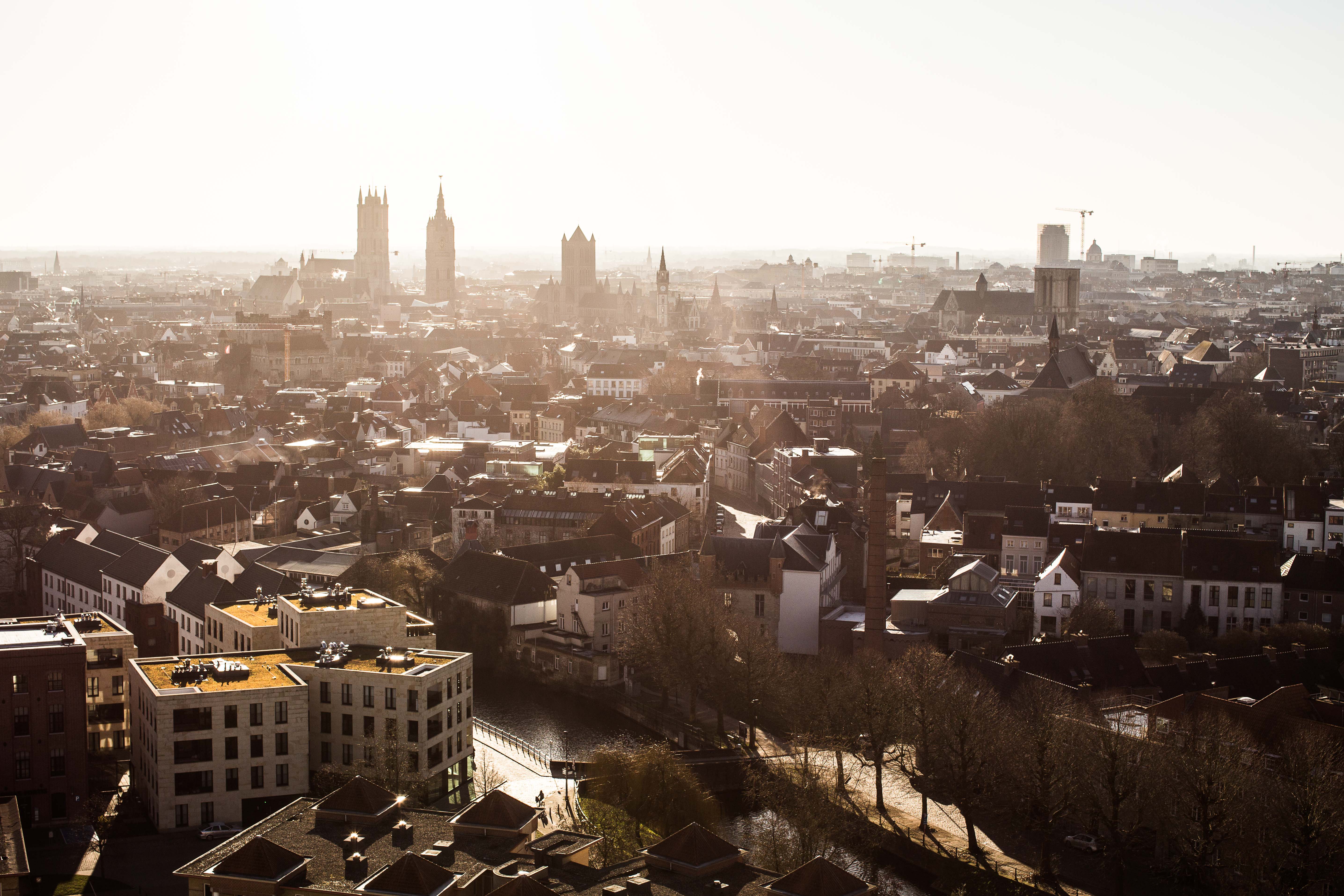
The Krook
This architectural work of art is a unique meeting place for residents, students and visitors. You can meet other people there, discover culture, enjoy a quiet drink or even try out innovations and technologies like 3D printing and virtual reality for yourself. As well as connecting people, the building links the Historic Centre with the Art Quarter.
Various institutions work together and offer services at the site. They are known collectively as ‘the inhabitants of De Krook’. In addition to the city library, Imec (the Flemish research centre for nanoelectronics and digital technologies) and UGent are housed at De Krook.
The building also includes a multi-purpose room, a study room and a reading café.
The monumental building, which incorporates works by artist Michaël Borremans, was designed by the Ghent architecture firm Coussée & Goris Architecten and their partner TV RCR Aranda Pigem Vilalta Arquitectes. This Spanish architecture firm also won the Pritzker Prize this year, the highest international distinction for architecture!
Patershol, culinary heart of Ghent
This particularly beautiful corner of Ghent is a city within the city. Forget where you are for a moment and travel back in time to the Middle Ages. Have fun discovering centuries of history in this gorgeous part of town! Breathe in the nostalgia of old customs. Enjoy art and architecture. You will love the picturesque streets full of cosy restaurants, down-to-earth pubs and trendy bars.
Ghent is heaven for foodies. But the Patershol is definitely at the top of everyone’s menu. Eateries are almost shoulder to shoulder in these tiny cobbled streets. Take a culinary trip around the world from Japanese and Indonesian food, past Turkish, Italian and Spanish restaurants to traditional Flemish cuisine. Pick your style, whether it’s modern, romantic, a bit eccentric or exclusive. You certainly won’t be leaving with an empty stomach.
Real people live their lives in the shadow of the Castle of the Counts. Residents here go about their daily business. They welcome neighbours through their doors. Children play in the street. The Patershol is more than a tourist hotspot. Above all, it is a place where people live. There is a festival committee that honours local traditions. All of this gives the mediaeval streets a unique historic value. Wander down the narrow alleyways and experience the real soul of the Patershol.
The Mystic Lamb: supreme divine art
The Mystic Lamb, or ‘The Adoration of the Mystic Lamb’ by the Van Eyck brothers, completed in 1432, is recognised worldwide as a great work of art, and one of the most influential paintings ever made. It is an absolute must-see on your weekend break to Ghent. A total of 18 panels form a magical evocation of scenes from the Bible, as well as a portrait of the church warden, Joos Vijd, who commissioned the altarpiece, and his wife Elisabeth Borluut.
“The Adoration of the Mystic Lamb is probably the most influential painting ever made, and it is also the most often stolen work of art in history!”
Noah Charney
The monumental Mystic Lamb was painted on oak panels covered in thin layers of a mixture of chalk and animal glue. The figures were applied in several layers of oil paint. The combination of the painstaking work and transparent paint creates an extra dimension. Discover it for yourself as you stand in front of this masterpiece. You will see that an inner glow seems to radiate from the painting: the light of the divine.
Hubert van Eyck painted part of the Ghent Altarpiece that includes the Mystic Lamb, but was never able to finish it. His younger brother Jan, an absolute master of the art of painting, is said to have finished this masterpiece a few years after Hubert’s death.
On the morning of 11 April 1934, Ghent woke up to news of a disaster. Two panels of the Ghent Altarpiece, ‘The Just Judges’ and ‘John the Baptist’ had been stolen from St Bavo’s Cathedral! This daring theft has grown to become one of the most fascinating art robberies of the 20th century. It remains unsolved.
Later the ‘John the Baptist’ panel was returned anonymously, but ‘The Just Judges’ is still lost without trace. Today you can find the Mystic Lamb where it belongs: in St Bavo’s Cathedral. Admittedly there is still a reproduction in the place of the stolen panel, ‘The Just Judges’. Whether or not the missing panel is ever found, this theft has given rise to all sorts of exciting stories and mysterious conspiracy theories.
Head to Ghent city museum, STAM, for a spot of detective work to track down the world-famous missing panel, ‘The Just Judges’.
The Mystic Lamb: devoted restoration
This world-famous masterpiece by the Van Eyck Brothers in Ghent has been restored many times in the past. It has been undergoing thorough restoration and conservation work since 2012. During its turbulent history, the Mystic Lamb has survived transportation, changes in temperature and humidity, horrifying attacks with a saw and fire damage. Contemplate the intensive renovation work on this religious masterpiece right before your eyes in the MSK. Stand behind bulletproof glass to watch 11 international restorers removing layers of varnish and later additions and touching up blemishes with paintbrushes. Unique and unbelievably fascinating! Does The Mystic Lamb make you want more? You’re in luck, because once a month the restoration team gives a talk on the restoration of this masterpiece.
Adore the Lamb
Here’s a fascinating fact: The Mystic Lamb was rescued in 1945 by the famous ‘Monuments Men’. The Mystic Lamb was welcomed home like a king by the ecstatic people of Ghent, who lined the streets in a respectful guard of honour. There is a film of the amazing story of the Monuments Men, American art commandos who brought confiscated art back to where it belonged. The film, ‘The Monuments Men’, begins in St Bavo’s Cathedral in Ghent. The people of Ghent adore the Mystic Lamb, and rightfully so, but they also have a sense of humour. You can see proof of this in this spoof video about the Mystic Lamb.
Heavenly graffiti in Ghent
Discover the graffiti version of the Mystic Lamb in Ghent during your city trip as well! When ‘The Monuments Men’ came out in the cinema, graffiti artist Bart Smeets spray-painted a huge mural on the side of the house on the corner of Van Stopenberghestraat, near St Bavo’s Cathedral. The film producer, 20th Century Fox, was looking for a contemporary way to draw attention to ‘The Monuments Men’. The city of Ghent welcomed this new painting with open arms as an ongoing promotion for the Mystic Lamb that plays a prominent role in the film.
Enchanted by the Mystic Lamb?
Does The Mystic Lamb make you want more? During your weekend getaway to Ghent, enjoy a guided walking tour around the city of Ghent. The Province of East Flanders and the guides’ associations also adore the altarpiece and offer city walks in Ghent on the theme of the Adoration of the Mystic Lamb.
The Castle of the Counts
A weekend trip to Ghent is simply not complete without a visit to the mysterious ‘Castle of the Counts’. This important sight in Ghent is a castle with a very turbulent past, closely intertwined with the complex — often stormy — political and social history of the city. It is the only remaining mediaeval castle with a moat and largely intact defence system in Flanders. Your visit to the Castle of the Counts will give you a complete picture of heraldic culture in the 12th century. The gatehouse, ramparts, keep, count’s residence and stables are open to visitors.
Be sure to go up the long spiral staircase to the museum of torture devices on the top floor of the Castle of the Counts. Here, you will find a unique collection of instruments for torture and coercion, as well as a collection of weapons. The Castle of the Counts also hosts all kinds of cultural activities, events and activities, for example during the Ghent Festivities. It is also a popular place to get married for Ghent’s locals.
Let’s not forget the time the Castle of the Counts was occupied by protesting students in 1949! Explore the castle during your weekend trip in Ghent and find out all about the ‘Battle of the Castle of the Counts’.
The keep, symbol of the Counts’ power
Go back in time inside this majestic fortress. Its history goes back to the time of the Roman occupation, when there was already a settlement on a sand bank by the River Lys. After a brief period of Viking plundering, the Counts of Flanders converted the earlier wooden constructions into a keep (living quarters) in the Middle Ages, with ramparts built entirely of stone, replete with 24 towers. The imposing building with its military architecture was a symbol of the Counts’ power in the turbulent city of Ghent.
Count Philip and his castle: dominating the city
Count Philip of Alsace wanted everyone to know that he was the boss. A Latin inscription above the entrance states that Count Philip (1168-1191) built the castle in 1180. The sense of wealth and power that his castle gave him is brought to life when you stand between the battlements at the top of the keep and gaze out over the vibrant city of Ghent.
Industrial revolution banishes knights from Ghent
You are bound to be fascinated by the twists and turns in the story of the Castle of the Counts during your weekend getaway. In the late 18th century, the Castle of the Counts was sold to private owners who later converted it into a factory complex. In 1807, the fortress in the heart of Ghent housed a cotton mill, and its outbuildings served as primitive dwellings for about fifty families of workers. When the mill and its workers left, the Castle of the Counts was in a state of complete disrepair, ready for demolition.
By that point, the Castle of the Counts was a symbol of abuse of power, feudal repression, horrific torture methods and a cruel inquisition as far as the people of Ghent were concerned. Restoration gave the Castle of the Counts a new meaning and world fame as Ghent’s most important tourist sight, partly due to the World Expo 1913, which took place in Ghent.
Do you want to dig deep into the history of Ghent? This is where you need to be. Ghent, full of charming history and modern vibrancy.