Great Butchers’ Hall
East Flanders has more than 175 traditional regional products. And in Ghent you can find them all handily displayed under one roof!
The Great Butchers’ Hall houses the Centre for East Flemish Regional Products. You will find everything here, whether you want individual products or a gift hamper. Or why not put together your own delicious gift? If you can’t wait to taste our specialities, reserve a table at the restaurant across the aisle and enjoy local dishes right there on the spot!
The Great Butchers’ Hall was originally a covered market. This hall, which dates back to the 15th century, was the central place where meat was inspected and traded. This was partly because selling meat door-to-door was forbidden in the Middle Ages. Delicious Ganda Ham is now hung up to dry in the magnificent exposed wooden rafters. This ham is still salted and dried by craftspeople following an age-old traditional recipe.
You might want to experience Ghent on a miniature scale as well. Beside the Great Butchers’ hall is the smallest pub in Ghent, ’t Galgenhuisje. This vibrant little café used to be one of the tripe shops. Animal entrails were sold in these huts, separated off from the market hall for reasons of hygiene. The little bar fills up quickly. But not to worry. There is plenty of room on the terrace, and it’s heated in winter!
Old St Elizabeth Beguinage
Beguine city in Ghent: a tolerant ‘holy corner’
The beguinages of Flanders and the Netherlands are always oases of calm and stillness, where you might still expect to see an old beguine mumbling her prayers in a doorway. Two of Ghent’s three beguinages have been included on the UNESCO World Heritage list.
Although the Old St Elizabeth Beguinage, in Begijnhofdries in Ghent, is no longer enclosed by a wall, making it simply part of the city, it still has a unique atmosphere. Today the Old St Elizabeth Beguinage is known as ‘holy corner’, a place of religious tolerance, because it has no less than three different churches: one is Roman Catholic, one is Orthodox and the other is Protestant.
From bleachfield to orchard
This open beguinage grew into something of a ‘beguine city’ in the 13th century, with a church, the ‘Grootjuffer’s House’, an infirmary, a chapel, more than a hundred houses for beguines, a bleachfield (a field where linen was laid out to bleach) and an orchard. After the French Revolution, with increasing industrialisation, the inhabitants moved to their new beguinage in Sint-Amandsberg in 1873.
The new Orthodox church in Sophie Van Akenstraat is a striking sight in Ghent. A visit here is more than worthwhile. Inside, the church is painted with frescos using the authentic Byzantine technique. The façade depicts the Twelve Apostles with mosaics in rounded niches.
Heavenly art on façades in Ghent
Do you want to see more of this colourful façade art during your city trip? You will find another gorgeous mosaic on the façade of the Royal Dutch Theatre on Sint-Baafsplein. Apollo, the Roman god of music and joy, is represented with his muses: song, dance and music. Ghent is full of historic charm and captivating interest.
St Michael’s Bridge, romantic Ghent
Fairy-tale view: take your Ghent selfie!
Click-click. St Michael’s Bridge is the place for romantic hearts. Grab your smartphone and take some spectacular selfies. Wherever you look, there is a breathtaking view: you are surrounded by 360 degrees of Ghent’s charming beauty. Get an extra-special fairy-tale view of the heart of Ghent at twilight, when all the historic sights are gorgeously illuminated.
In short, St Michael’s Bridge is where you will find out what makes the people of Ghent and everyone who has been here love Ghent so much.
Pause for a view of the three towers
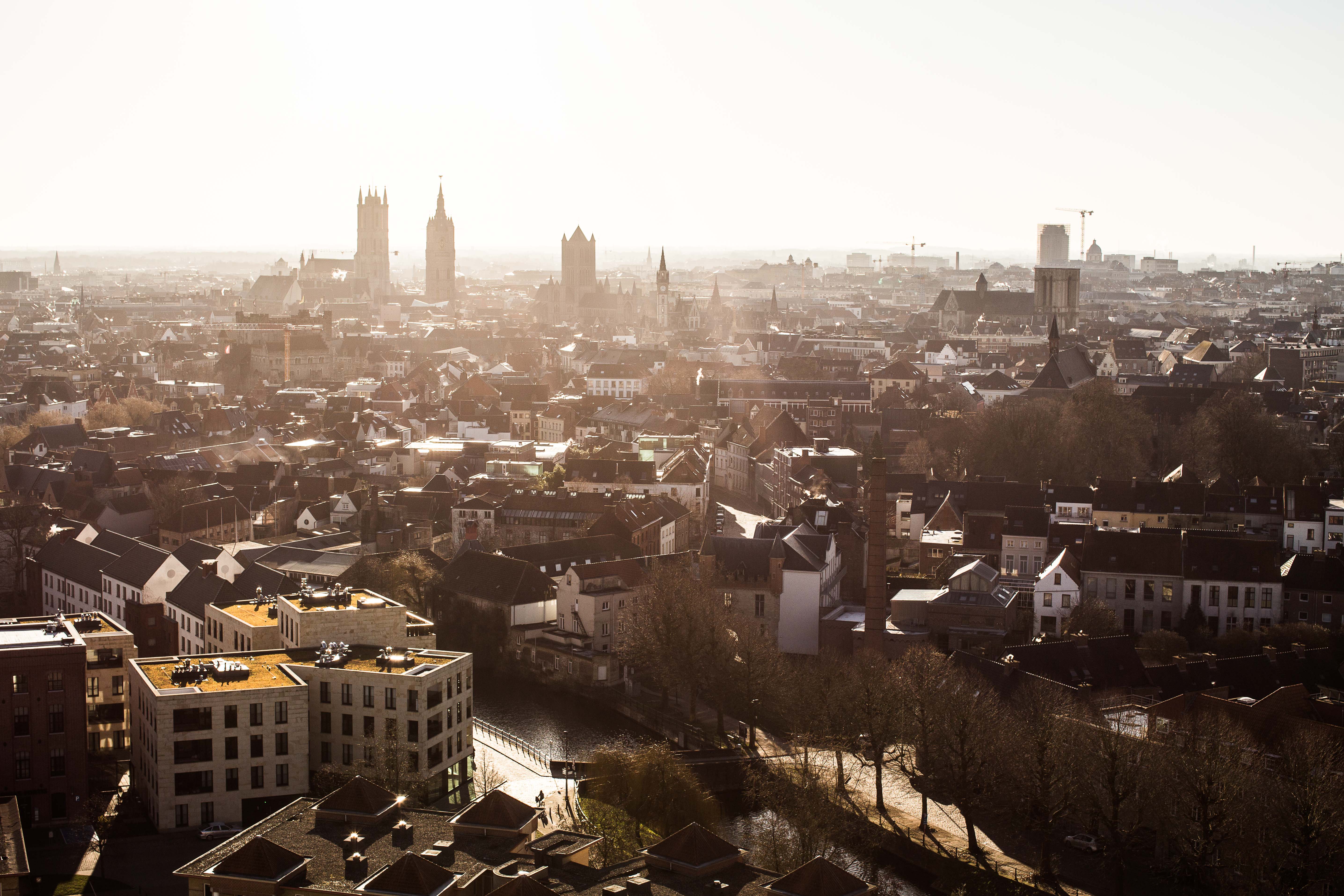
Experience a moment to remember on St Michael’s Bridge during your weekend in Ghent. Pause here to enjoy the picture-postcard views: the Graslei and Korenlei with the Old Fish Market, the Castle of the Counts in the distance, St Michael’s Church, the back of Het Pand and, of course, all three of Ghent’s famous towers in a row. It is only from this bridge that you can capture all three of them in one single picture.
St Michael’s Bridge used to be a flat turntable bridge, but it was replaced by stone arches at the beginning of the 20th century. In the middle of the bridge is a beautiful central lantern with a bronze statue of St Michael. Cameras at the ready!