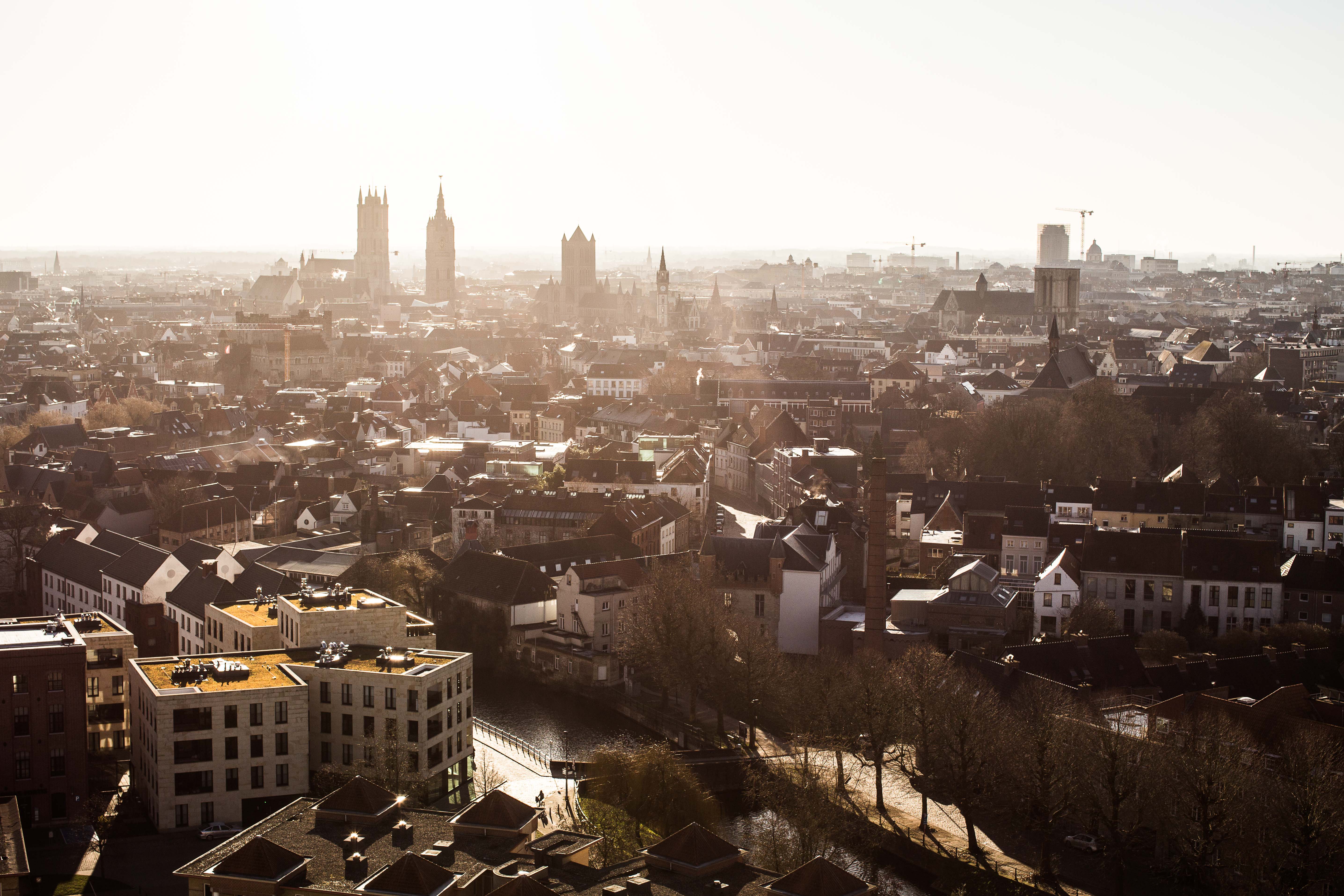
St Bavo’s Cathedral: majestic tower
Powerful Ghent church and home of the Mystic Lamb
This magnificent sight on Sint-Baafsplein in Ghent is a proud old lady: don’t just walk past her on your city trip. St Bavo’s Cathedral is the oldest parish church in the lively heart of Ghent. It stands on the site of a 10th century church and a 12th century Romanesque church. The latter was dedicated to St John the Baptist. In the Middle Ages, Ghent was a rich and powerful city that had the means to commission ever-larger and more opulent churches. So the Church of St John the Baptist was converted during the 15th and 16th centuries into the imposing Gothic St Bavo’s Cathedral.
A history of rebellion: from church to cathedral
Looking for a weekend getaway that is just that little bit different? Do you like to explore off the beaten track? Welcome to Ghent, the city of rebels! St Bavo’s Cathedral literally carries Ghent’s rebellious history in its very stones. In the crypt, the Romanesque style can still be seen in the central nave. In the 15th century, it was decided that the Romanesque structure would be replaced with a larger Gothic church that was completed in 1559. In 1540, the church became the seat of the Chapter of St Bavo, and St Bavo became the patron saint of the church. Later, in 1559, the church was converted into the cathedral of the Bishops of Ghent.
Bursting with riches: Ghent’s art treasures
St Bavo’s Cathedral has a rich history and it is also filled with art treasures that make many an art-lover’s mouth water: from the baroque high altar in white, black and red flamed marble, the Rococo pulpit in oak, gilded wood and marble, to a masterpiece by Rubens: Saint Bavo enters the Convent at Ghent, and the Calvary Triptych by Justus van Gent, the Gothic chandelier/sanctuary lamp, the opulent tombs of the Bishops of Ghent – and of course the world-famous Mystic Lamb.
Admire the divine glow of ‘The Adoration of the Mystic Lamb’ by the Van Eyck brothers in St Bavo’s Cathedral. Read all about this famous work by the Flemish Primitives. Do you want to visit the Mystic Lamb? Find out the opening hours of the chapel where the Mystic Lamb is on display at St Bavo’s Cathedral.
Fascinating fact about the Mystic Lamb: So that you have a chance to admire all the panels of the Ghent Altarpiece in all their glory, the outer panels of this masterpiece by Van Eyck are folded inwards every day between 12.00 and 13.00. Admission tickets for this chapel are sold until about 15 minutes before closing time.
Souvenirs galore: the cathedral shop
Of course you want memories to take home with you that are as beautiful as the cathedral itself. Pop into the cathedral gift shop for postcards, art books, posters etc.
‘Festive’ view of the city of Ghent
You can only go up the tower of St Bavo’s Cathedral during the Ghent Festivities. Negotiate the stairs and enjoy the magnificent view of this unique party for the people in the heart of Ghent. At other times of the year, you can enjoy the most beautiful view of Ghent from directly beneath the golden dragon, Ghent’s mascot, on the Belfry tower opposite. From there you can continue exploring the heart of Ghent. Anything goes.
The Castle of the Counts
A weekend trip to Ghent is simply not complete without a visit to the mysterious ‘Castle of the Counts’. This important sight in Ghent is a castle with a very turbulent past, closely intertwined with the complex — often stormy — political and social history of the city. It is the only remaining mediaeval castle with a moat and largely intact defence system in Flanders. Your visit to the Castle of the Counts will give you a complete picture of heraldic culture in the 12th century. The gatehouse, ramparts, keep, count’s residence and stables are open to visitors.
Be sure to go up the long spiral staircase to the museum of torture devices on the top floor of the Castle of the Counts. Here, you will find a unique collection of instruments for torture and coercion, as well as a collection of weapons. The Castle of the Counts also hosts all kinds of cultural activities, events and activities, for example during the Ghent Festivities. It is also a popular place to get married for Ghent’s locals.
Let’s not forget the time the Castle of the Counts was occupied by protesting students in 1949! Explore the castle during your weekend trip in Ghent and find out all about the ‘Battle of the Castle of the Counts’.
The keep, symbol of the Counts’ power
Go back in time inside this majestic fortress. Its history goes back to the time of the Roman occupation, when there was already a settlement on a sand bank by the River Lys. After a brief period of Viking plundering, the Counts of Flanders converted the earlier wooden constructions into a keep (living quarters) in the Middle Ages, with ramparts built entirely of stone, replete with 24 towers. The imposing building with its military architecture was a symbol of the Counts’ power in the turbulent city of Ghent.
Count Philip and his castle: dominating the city
Count Philip of Alsace wanted everyone to know that he was the boss. A Latin inscription above the entrance states that Count Philip (1168-1191) built the castle in 1180. The sense of wealth and power that his castle gave him is brought to life when you stand between the battlements at the top of the keep and gaze out over the vibrant city of Ghent.
Industrial revolution banishes knights from Ghent
You are bound to be fascinated by the twists and turns in the story of the Castle of the Counts during your weekend getaway. In the late 18th century, the Castle of the Counts was sold to private owners who later converted it into a factory complex. In 1807, the fortress in the heart of Ghent housed a cotton mill, and its outbuildings served as primitive dwellings for about fifty families of workers. When the mill and its workers left, the Castle of the Counts was in a state of complete disrepair, ready for demolition.
By that point, the Castle of the Counts was a symbol of abuse of power, feudal repression, horrific torture methods and a cruel inquisition as far as the people of Ghent were concerned. Restoration gave the Castle of the Counts a new meaning and world fame as Ghent’s most important tourist sight, partly due to the World Expo 1913, which took place in Ghent.
Do you want to dig deep into the history of Ghent? This is where you need to be. Ghent, full of charming history and modern vibrancy.