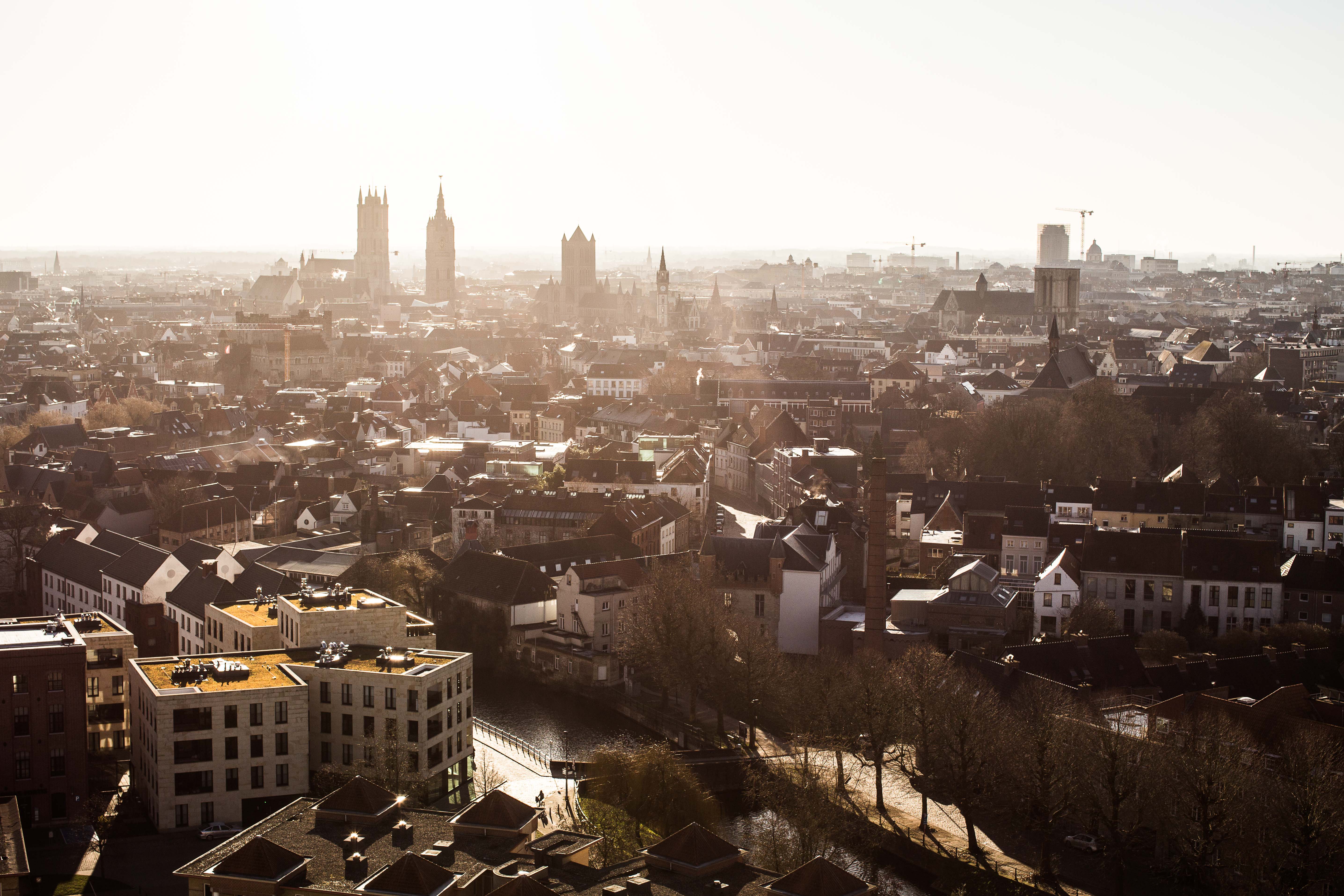
Ghent Belfry, world heritage
Look up at the magical city skyline for a moment during your weekend trip in Ghent: you can’t miss it. The Belfry is the middle tower in the famous row of three, between St Bavo’s Cathedral and St Nicholas’ Church. A fiery dragon, the proud symbol and mascot of Ghent, guards the historic heart of the city.
The Ghent Belfry symbolises the city’s prosperity and independence. The Cloth Hall, built onto the Belfry, was completed in 1907. The flamboyant Brabant Gothic style of the Cloth Hall is an ode to the industry to which Ghent owes so much. On the corner of the Cloth Hall is an old jailer’s house.
The Ghent Belfry, a recognised UNESCO World Heritage, is well worth a visit. In 1402, it was the place where city privileges were kept: in a chest, locked up in the Belfry safe. The dragon, which has been up on the tower since 1377, kept an eye on the city as well as being the symbolic guardian of the belfry. The Belfry also proudly carried the alarm bell, the ‘Great Triumphant’. Today you will find this bell, nicknamed ‘Roland’ by the people of Ghent, not far from the Belfort on Emile Braunplein.
Until 1442, St Nicholas’ Church was the main watchtower. In 1442, the watchmen in the tower moved across to the newly completed Belfry. Along with the bell ringers, these watchmen, or the corps of ‘men who guard the city’, served until 1869. Fire was a particular danger in Ghent.
The Belfry tower is an absolute must-see! Climb the stairs, listen to the chiming sound of the carillon and enjoy the view of the vibrant city of Ghent. There is a lift from the first floor. The stunning view over Ghent is bound to enchant you. However, the Belfry is not accessible to visitors with reduced mobility.
The Mammelokker, a legend behind bars
In 1741, a building was erected between the Belfry and the Cloth Hall, which served as the entrance to the city jail. You will see a relief sculpture above the entrance. The sculpture tells an old Roman legend of a man, Cimon, who was sentenced to death by starvation. He survived his sentence because his daughter visited every day and breastfed him. ‘Mamme’ means ‘breast’ and ‘lokken’ means ‘suck’ in an old Ghent dialect.
The Belfort, great fun for little dragons
Ghent wouldn’t be Ghent without children and young people, so Ghent Belfry also has plenty to offer little dragons. Here you will find activities for kids aged 6 to 18 years old. Kids up to the age of 100 are more than welcome here as well ;-).
Child-friendly Ghent: have fun on your weekend trip with the whole family. Do you know about the city game with Fosfor the dragon as well?
S.M.A.K.: contemporary art in Ghent
Lovers of contemporary art absolutely can’t afford to miss a visit to the S.M.A.K. during their weekend in Ghent. The Municipal Museum of Contemporary Art, or S.M.A.K. for short (in Dutch), was founded in 1999 and is located opposite the MSK in a former casino building.
The city of Ghent is known for its rebelliousness, and its contemporary art museum is every bit as dynamic and unconventional as Ghent itself. The collection is considered to be the most important collection of contemporary art in Flanders, with world-famous works of art from Belgium and abroad. Every four months, the museum exhibits a selection of these works in alternation with original, often daring exhibitions. Recover at leisure from the assault on your senses in the museum café.
Take a look at the sculpture by Jan Fabre on the roof: the body of ‘The Man who Measures the Clouds’ is modelled on Fabre himself, but the face belongs to his dead brother.
Under the inspiring leadership of the controversial curator and ‘art pope’ Jan Hoet, the former ‘contemporary art wing’ of the MSK was given its own museum, the S.M.A.K. The permanent collection at this museum for contemporary art includes top Belgian and international works of art by Cobra, pop art, minimal art, conceptual art and arte povera artists, who are now among the most famous artists in the world.